
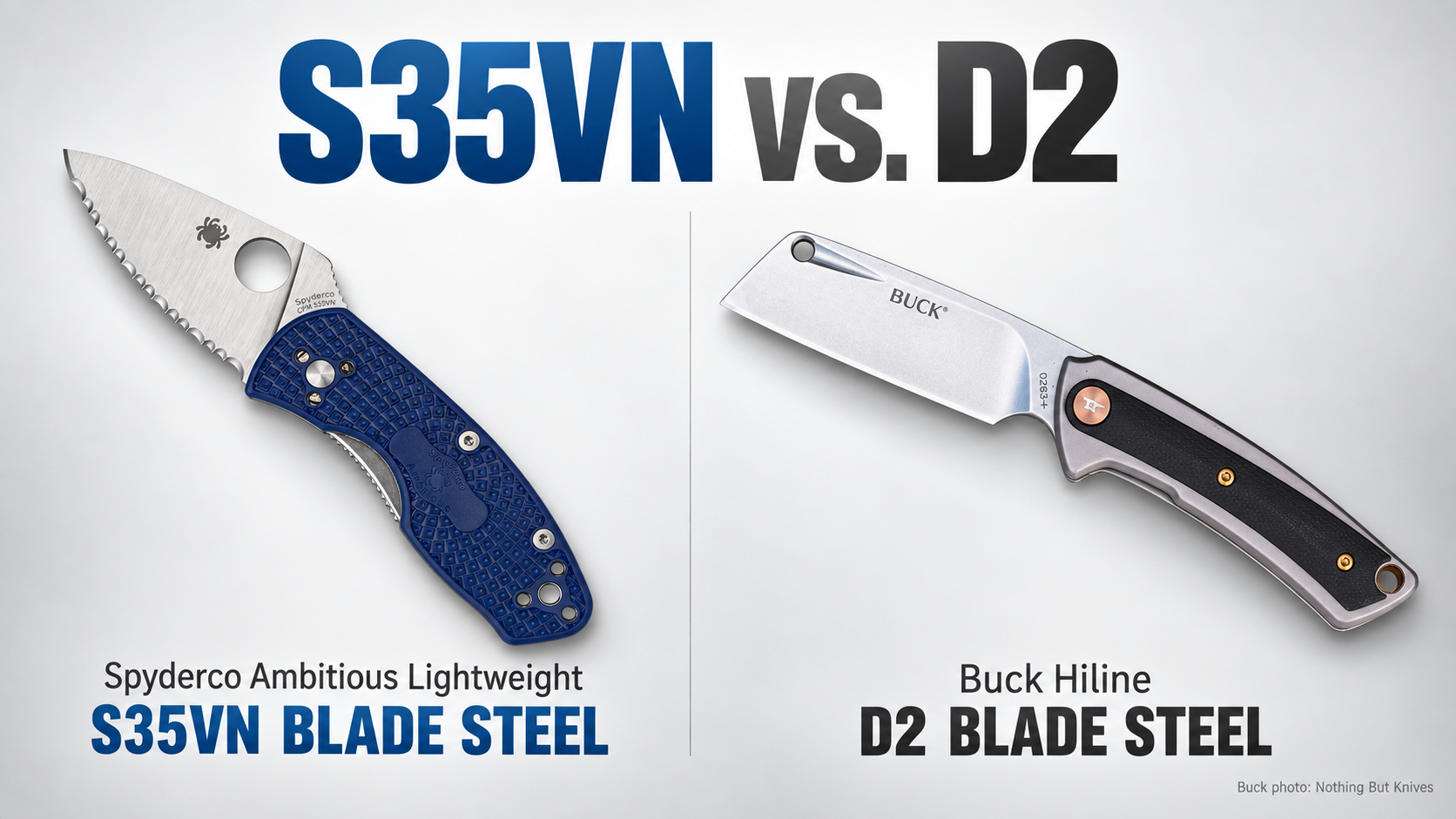
S35VN vs D2
6 Surprising Differences (Best Steel for EDC)

If you’ve been shopping for an EDC knife in the $30 to $200 range, you’ve almost certainly seen both of these steels on a spec sheet. In the S35VN vs D2 debate, you’re really looking at two different philosophies of knife steel. D2 is a decades-old industrial tool steel that became the go-to “upgrade” steel for budget knives. S35VN is a modern powder-metallurgy stainless steel designed specifically with knife makers in mind.
Both can make an excellent everyday carry blade, but they get there in very different ways, and the price gap between knives using them is often significant. This S35VN vs D2 breakdown covers where each steel comes from, how their chemistry shapes real-world performance, and which one makes more sense for the way you actually use a knife.
Quick Answer: In the S35VN vs D2 comparison, S35VN beats D2 in edge retention, toughness, and especially corrosion resistance, making it the better all-around steel for a knife you plan to carry for years. D2 wins on price and value, and it’s slightly easier to sharpen on conventional stones, which makes it a great pick for budget EDC knives and beaters. In the D2 vs S35VN matchup, the real question is whether the performance jump is worth the extra cost to you.
Where These Steels Come From
D2 is one of the oldest steels you’ll still find on a modern pocketknife. It’s an air-hardening, high-carbon, high-chromium tool steel that was originally developed for industrial work like dies, punches, and shear blades, where holding up to abrasive wear mattered more than anything else. Because it’s widely produced, inexpensive, and holds an edge well for the money, knife manufacturers adopted it heavily. Today it’s the standard “step up” steel on budget and midrange knives from brands like CIVIVI, QSP, Ganzo, and dozens of others. D2 is made using conventional ingot casting, which becomes important when we get to toughness.
S35VN comes from Crucible and is part of its CPM (Crucible Particle Metallurgy) family. It was developed around 2009 in collaboration with Chris Reeve as an improved version of the popular CPM S30V. The goal was to keep S30V’s excellent balance of edge retention and corrosion resistance while making the steel tougher and easier to finish and sharpen. The “N” in S35VN refers to niobium, a small addition that helps refine the steel’s grain structure.
For most of the 2010s, S35VN was the default “premium” steel on production knives from Chris Reeve, Spyderco, Kizer, WE Knife, and many others. It has since been joined by newer steels like S45VN and MagnaCut, but it remains a proven, widely available performer, and that history is key to understanding the S35VN vs D2 debate today.
Breaking Down the Chemistry
Steel performance comes down to composition, and the S35VN vs D2 chemistry gap explains most of the differences you’ll feel in use. D2 runs roughly 1.5% carbon, 12% chromium, 0.8% molybdenum, and 0.9% vanadium. S35VN runs closer to 1.4% carbon, 14% chromium, 2% molybdenum, 3% vanadium, and 0.5% niobium. The differences that matter most:
- Chromium and corrosion resistance: D2’s 12% chromium sounds like a lot, but much of it gets tied up in chromium carbides during heat treatment. That leaves less “free” chromium in the steel to fight rust, which is why D2 is usually described as semi-stainless. S35VN’s higher chromium content and different carbide structure make it a true stainless steel.
- Vanadium carbides: S35VN has more than three times the vanadium of D2. Vanadium forms very hard, very small carbides that boost wear resistance, which is a big part of why S35VN holds an edge longer.
- Carbide size and structure: This is the biggest practical difference. Because D2 is conventionally cast, it forms large, clumped chromium carbides. S35VN’s powder-metallurgy process produces tiny, evenly distributed carbides. Small, even carbides mean a tougher edge that’s less likely to chip and can be sharpened to a finer, more refined apex.
- Niobium: The small niobium addition in S35VN refines the grain and improves toughness compared to its predecessor, S30V.
In short, the S35VN vs D2 chemistry comes down to this: S35VN uses modern metallurgy to deliver a cleaner, more balanced steel, while D2 relies on sheer carbide volume from an older production process to deliver solid wear resistance at a low cost.
D2 vs S35VN: Quick Comparison Chart
| Property | S35VN | D2 |
|---|---|---|
| Steel Type | Powder-metallurgy stainless (Crucible CPM) | Conventional semi-stainless tool steel |
| Composition | ~1.4% C, 14% Cr, 2% Mo, 3% V, 0.5% Nb | ~1.5% C, 12% Cr, 0.8% Mo, 0.9% V |
| Typical Hardness | 58–61 HRC | 58–61 HRC |
| Edge Retention | Very good — better | Good |
| Corrosion Resistance | Very good — clearly better | Fair — can rust or stain |
| Toughness | Good — better | Fair — prone to chipping |
| Ease of Sharpening | Moderate — diamond stones help | Moderate — slightly easier on standard stones |
| Price Tier | Midrange to premium | Budget to midrange |
| Best For | Long-term EDC, humid climates, outdoor use | Budget EDC, beater knives, dry climates |
Edge Retention: S35VN vs D2
D2 has a well-earned reputation for holding an edge far better than its price suggests. Its high carbide volume gives it strong resistance to abrasive wear, and a well-heat-treated D2 blade will outlast common budget steels like 8Cr13MoV, AUS-8, and 14C28N in cardboard and rope cutting. That’s the main reason it became so popular on budget knives.
S35VN still comes out ahead in the S35VN vs D2 edge retention test. Its hard vanadium carbides give it more wear resistance, and in controlled cutting tests it consistently outperforms D2 at similar hardness. In everyday use, that means more boxes, more zip ties, and more rope before your edge starts to slide instead of bite. The gap isn’t enormous, but it’s noticeable if you use your knife a lot. Winner: S35VN, by a clear but moderate margin.
S35VN vs D2 Corrosion Resistance
This is the most lopsided category in the S35VN vs D2 comparison. D2 is semi-stainless, which means it resists rust better than a true carbon steel like 1095 but can still develop spots, staining, or a patina if it’s left wet, exposed to sweat, or carried in a humid environment.
Many D2 knives ship with a stonewashed or coated finish partly to help hide and slow this. S35VN is a genuine stainless steel. It shrugs off everyday moisture, handles food prep without complaint, and is a much safer choice for fishing, boating, or anyone who pocket-carries in hot, sweaty weather. Here in the Arizona desert, D2 is easy to live with. In Florida or on a boat, it’s a different story. Winner: S35VN, easily.
Toughness: S35VN vs D2
Toughness is where D2’s older production method holds it back. Those large, clumped chromium carbides act as weak points in the steel, and a thin D2 edge is more prone to micro-chipping when it hits something hard like a staple, a knot in wood, or the edge of a cutting board.
That doesn’t make D2 fragile for normal EDC tasks, but it’s not the steel you want for batoning or prying. S35VN’s fine, evenly spread carbides give it noticeably better toughness. In fact, improving toughness over S30V was one of the main reasons S35VN was created. It holds a thin edge more reliably and resists chipping better under lateral stress, which makes toughness one of the clearest wins for S35VN in the S35VN vs D2 matchup. Winner: S35VN.
Ease of Sharpening
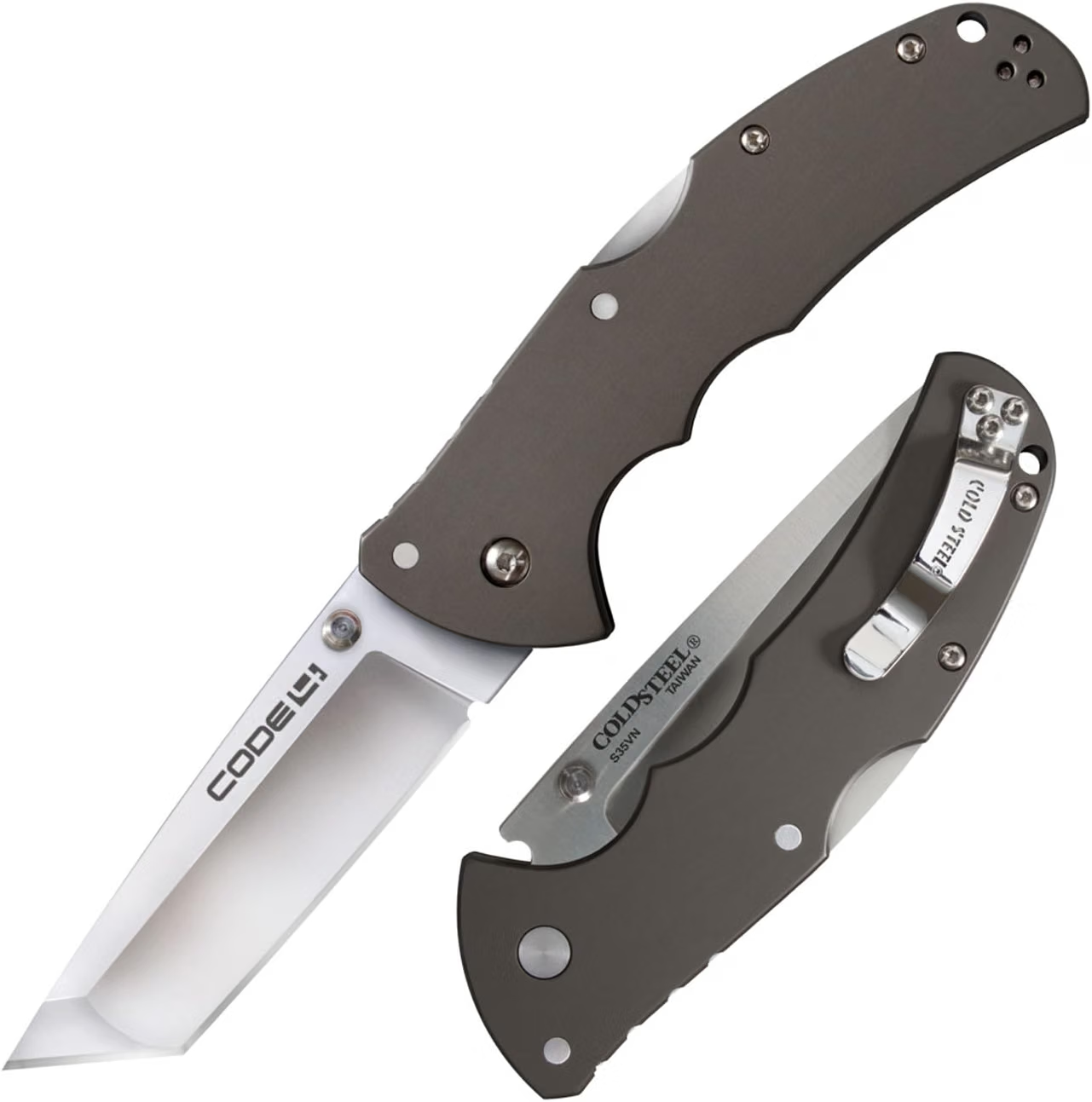
Sharpening is the one performance category where the S35VN vs D2 gap narrows. Neither steel is a pushover on the stones. D2’s chromium carbides are hard enough to slow down basic sharpening, and its large carbides can make it a little tricky to get a highly polished, hair-whittling edge. However, it responds reasonably well to standard aluminum oxide and ceramic stones, and it’s very forgiving for people using guided systems.
S35VN’s vanadium carbides are harder than aluminum oxide, so conventional stones will work but more slowly. Diamond stones make S35VN much easier and help it take a very fine, refined edge thanks to its smaller carbides. If you already own diamond plates, the difference is small. If you’re working with a basic whetstone, D2 will be a bit less frustrating. Winner: D2, by a slim margin, and mostly for people using conventional stones.
Cost and Availability
Price is where the S35VN vs D2 comparison tips back toward D2, and it’s D2’s biggest advantage. D2 is inexpensive to produce and easy to machine, so you’ll find it on excellent knives in the $20 to $60 range, including many solid budget EDC picks. S35VN costs more as a raw material and is harder to grind and finish, so knives using it typically start around $80 and climb well past $200. Both are very easy to find, though some brands have moved their premium lines from S35VN to newer steels like S45VN or MagnaCut. That shift has actually made some excellent S35VN knives easier to find on sale. Winner: D2 on value.
S35VN vs D2: Which Should You Choose?
When it comes to picking a side in S35VN vs D2, most people will be happy with either one. Both steels will do everything an everyday carry knife needs to do. Opening packages, breaking down boxes, cutting cord, and food prep are all well within the capabilities of either one. The choice comes down to budget, climate, and how long you plan to keep the knife. Here’s a simple way to think about it:
- Choose S35VN if you want a knife you’ll carry for years, you live somewhere humid or near saltwater, you use your knife heavily, or you want a tougher edge that resists chipping. It’s the better all-around steel and a noticeable step up in performance.
- Choose D2 if you’re on a budget, you want a beater knife you won’t worry about, you live in a dry climate, or you sharpen on conventional stones. A good D2 knife offers some of the best value in the knife world.
If you’re choosing between two otherwise similar knives, the S35VN vs D2 answer is simple: S35VN is the better steel on paper and in the pocket. But a well-made D2 knife at half the price is still a smart buy, and many enthusiasts keep one of each: a D2 knife for the dirty jobs and an S35VN knife for daily carry. For a look at how D2 stacks up against another popular budget steel, check out our N690 vs. D2 comparison.
Frequently Asked Questions
Is S35VN better than D2?
For overall performance, yes. In the S35VN vs D2 comparison, S35VN beats D2 in edge retention, toughness, and corrosion resistance thanks to its powder-metallurgy production and higher vanadium and chromium content. D2’s advantages are lower cost and slightly easier sharpening on conventional stones, which make it one of the best value steels available.
Will D2 steel rust?
It can. D2 is a semi-stainless tool steel, so it resists rust better than carbon steels but can still develop spots or staining if left wet or exposed to sweat and humidity. Wiping the blade dry and applying a light coat of oil prevents most issues. S35VN is fully stainless and far more resistant to corrosion.
Which holds an edge longer, S35VN or D2?
S35VN holds an edge longer. Its hard vanadium carbides provide more wear resistance than D2’s chromium carbides, so it keeps a working edge through more cutting before needing a touch-up. D2 still holds an edge very well for its price, outperforming most budget steels.
Is D2 steel good for an EDC knife?
Yes. D2 is a great steel for a budget EDC knife, offering solid edge retention at a low price. It works best in dry climates and for users who don’t mind wiping their blade down occasionally. If you want better rust resistance and toughness, S35VN is a worthwhile upgrade in the S35VN vs D2 comparison.
Related Articles:
N690 vs D2: 6 Surprising Differences (Ultimate Guide)
M390 vs. Elmax: The Ultimate Guide to 6 Key Differences
5 Shocking Secrets About K110 Blade Steel You Need to Know
D2 vs M390 vs MagnaCut