
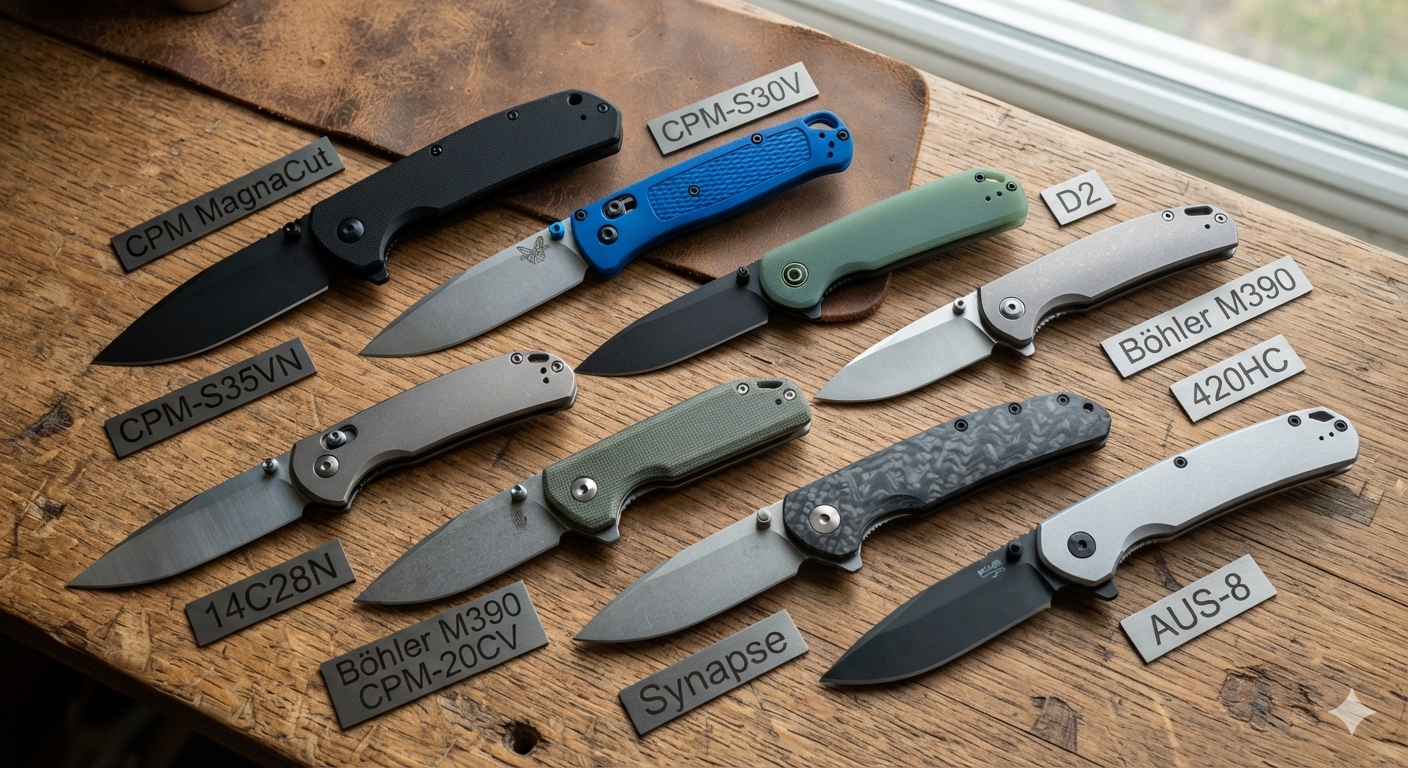
Blade Steel Comparison Chart

This blade steel comparison chart puts 22 of the most popular knife steels side by side, from premium powder steels like MagnaCut, M390, and S90V to budget favorites like D2, Nitro-V, and 8Cr13MoV. Tap any column header to sort the chart by the property that matters most to you. Every rating in this blade steel comparison uses a 1–10 scale, where 10 is the best performance in that category.
| Steel | Edge Retention | Toughness | Corrosion Resistance | Ease of Sharpening | Price Tier | Best For |
|---|---|---|---|---|---|---|
| CPM MagnaCut | 7 | 8 | 9 | 5 | $$$ | All-around premium EDC |
| CPM-S30V | 7 | 5 | 7 | 4 | $$$ | Long-lasting working edge |
| CPM-S35VN | 6 | 6 | 7 | 5 | $$$ | Balanced premium EDC |
| CPM-S45VN | 7 | 6 | 8 | 4 | $$$ | Upgraded premium EDC |
| CPM-S90V | 10 | 3 | 7 | 1 | $$$$ | Extreme edge retention |
| Böhler M390 / CPM-20CV | 8 | 4 | 9 | 3 | $$$$ | Maximum edge retention |
| CTS-XHP | 7 | 5 | 8 | 4 | $$$ | Edge holding with rust resistance |
| Böhler ELMAX | 7 | 6 | 8 | 5 | $$$ | Well-rounded premium EDC |
| Böhler Vanax | 5 | 6 | 10 | 6 | $$$$ | Saltwater and marine use |
| SLD-MAGIC | 7 | 6 | 4 | 4 | $$$ | Enthusiasts and collectors |
| CPM-3V | 5 | 10 | 2 | 6 | $$$ | Hard-use outdoor and survival |
| CPM-154 | 5 | 6 | 7 | 6 | $$ | Refined mid-range EDC |
| 154CM | 5 | 5 | 6 | 6 | $$ | Classic American EDC |
| 14C28N | 3 | 8 | 8 | 9 | $$ | Tough, low-maintenance budget blades |
| Nitro-V | 3 | 7 | 8 | 8 | $$ | Budget hard-use and outdoors |
| VG-10 | 4 | 4 | 7 | 7 | $$ | Kitchen and slicing |
| D2 | 5 | 3 | 3 | 5 | $ | Budget edge holding |
| 440C | 4 | 4 | 6 | 7 | $ | Traditional stainless blades |
| AUS-8 | 3 | 6 | 6 | 8 | $ | Budget all-rounder |
| 1095 | 3 | 7 | 1 | 9 | $ | Bushcraft and traditional knives |
| 8Cr13MoV | 2 | 6 | 5 | 9 | $ | Entry-level beater knives |
| 420HC | 2 | 7 | 7 | 10 | $ | Outdoor utility, field sharpening |
How to Choose the Right Blade Steel
Every blade steel comparison comes down to trade-offs. The steels that hold an edge longest usually give up some toughness and take more effort to sharpen, while the easiest steels to sharpen dull faster. No steel wins every column in the chart, so the right choice depends on how you use your knife and how much maintenance you’re willing to do.
Start With How You Use Your Knife
If most of your cutting is opening boxes, breaking down cardboard, and cutting tape or cord, edge retention is the column to watch. Cardboard is surprisingly abrasive, and steels like S90V, M390, 20CV, CTS-XHP, S45VN, and MagnaCut go noticeably longer between sharpenings. S90V sits at the top of the chart for edge life, but it’s also one of the hardest steels to sharpen.
If you baton wood, pry, or use your knife hard outdoors, prioritize toughness instead. CPM-3V is the toughest steel in this chart and a favorite for fixed blades and survival knives. MagnaCut, 14C28N, Nitro-V, 1095, and 420HC are also much less likely to chip or snap than harder, carbide-heavy steels like D2, M390, or S90V.
Consider Where You Carry
Sweat, humidity, salt air, and food acids all cause rust. If you pocket-carry all day, spend time near the water, or cut food with your EDC, pick a steel with a high corrosion score such as Vanax, MagnaCut, M390, or 14C28N. Vanax is a nitrogen-based steel that is about as close to rustproof as a knife steel gets, which makes it a top choice for fishing and boating knives.
D2 and SLD-MAGIC are only semi-stainless and will spot if they’re left wet, so they reward owners who wipe their blades down. CPM-3V and 1095 are not stainless at all. Both need a protective coating or regular oiling, and 1095 will develop a patina with use.
Be Honest About Sharpening
High-vanadium steels like S90V, M390, S30V, S45VN, and S35VN are packed with extremely hard vanadium carbides. That’s why they hold an edge so long, but it also means they sharpen slowly on conventional stones, and you’ll want diamond plates or a guided system when they finally dull. S90V is the most demanding steel in this blade steel comparison to sharpen. If you’d rather do a quick touch-up on a basic stone, 420HC, 1095, 8Cr13MoV, 14C28N, Nitro-V, and AUS-8 all sharpen easily.
Match the Steel to Your Budget
Powder metallurgy steels like MagnaCut, S30V, S35VN, S45VN, S90V, CTS-XHP, ELMAX, Vanax, and M390 cost more to produce and usually appear on higher-priced knives. Mid-range options like 154CM and CPM-154 offer a nice step up from budget steels without premium pricing.
Budget steels like 8Cr13MoV, D2, 440C, 14C28N, and Nitro-V dominate the lower price ranges, and 14C28N and Nitro-V in particular perform well above their price. For a first knife, a well-made 14C28N or D2 folder is a better buy than a premium steel in a poorly built knife.
Heat Treatment Matters as Much as the Steel
The ratings in this chart assume a good heat treatment, and that’s true of any blade steel comparison you’ll find online. A well-treated 14C28N can outperform a poorly treated S30V, and budget D2 in particular varies widely from brand to brand. A maker’s reputation for consistent heat treatment is just as important as the steel listed on the spec sheet.
Quick Picks
Want the short version of this blade steel comparison? Here’s where each steel comes out on top:
- Best all-around: CPM MagnaCut
- Longest edge retention: CPM-S90V
- Best edge retention with easier upkeep: Böhler M390 / CPM-20CV
- Toughest: CPM-3V
- Most rust resistant: Böhler Vanax
- Best budget steel: 14C28N or Nitro-V
- Best budget edge holding: D2
- Best mid-range steel: CPM-154
- Best for bushcraft: 1095 or CPM-3V
- Easiest to sharpen: 420HC
Blade Steel Comparison Chart FAQ
What is the best all-around knife steel?
For most people, CPM MagnaCut. It combines high toughness, excellent corrosion resistance, and good edge retention in a single steel, a balance older steels forced you to trade away. It was designed by metallurgist Larrin Thomas and released in 2021, and it has quickly become the go-to steel for premium EDC knives. If you want the longest possible edge life and don’t mind harder sharpening, M390, 20CV, or S90V is the alternative.
Is MagnaCut worth the price?
If you want one knife that handles everything with minimal maintenance, yes. If your cutting is mostly light tasks and you touch up your edge regularly, a budget steel like 14C28N or Nitro-V gets you most of the way there for a fraction of the cost.
Is D2 a good knife steel?
D2 is a solid budget steel that holds an edge better than most steels in its price range. The trade-offs are lower toughness, only moderate rust resistance, and quality that varies a lot with heat treatment. It’s a great value if you keep your knife dry and don’t use it for prying or heavy impacts.
Is D2 better than 8Cr13MoV?
For edge retention, yes, and the difference is noticeable. 8Cr13MoV is tougher, more rust resistant, and much easier to sharpen, though. Choose D2 if you want an edge that lasts longer, or 8Cr13MoV if you want a low-maintenance beater that’s quick to touch up.
What is the difference between S30V and S35VN?
S35VN was developed by Crucible as an improvement on S30V. It swaps some of the vanadium for niobium, which gives it a finer structure, slightly better toughness, and easier sharpening, at the cost of slightly lower edge retention. In real-world use the difference is small.
Is S45VN better than S35VN?
Slightly. S45VN is the newest step in the S30V family. It adds a bit more chromium and niobium, which improves corrosion resistance and edge retention over S35VN while keeping similar toughness. Many brands have moved their premium knives from S35VN to S45VN, and it’s an easy steel to recommend.
Is S90V better than M390?
For edge retention, yes. S90V has much more vanadium than M390 and holds an edge noticeably longer in slicing tests. The trade-off is that it’s less tough and much harder to sharpen, so it suits users who cut a lot of abrasive material and own diamond sharpening gear. M390 is the better choice for most people who want long edge life without as much sharpening effort.
Is M390 the same as 20CV?
Nearly. Böhler M390 is made in Austria and CPM-20CV is made in the United States, but their compositions are almost identical and they perform essentially the same. In any blade steel comparison, you can treat them as interchangeable.
What is the difference between M390 and ELMAX?
Both are Böhler powder steels. M390 holds an edge longer and resists corrosion a little better, while ELMAX is somewhat tougher and easier to sharpen. ELMAX is a great choice if you want premium performance with less chipping risk and simpler maintenance.
What is the difference between 154CM and CPM-154?
They share the same chemistry, but CPM-154 is made with Crucible’s powder metallurgy process. That gives it a finer, more uniform structure, which translates to slightly better toughness, a cleaner edge, and easier polishing. 154CM is the classic version and is still a reliable American steel used by brands like Benchmade.
Is 440C a good knife steel?
440C is a dependable, old-school stainless steel. It holds an edge reasonably well, resists rust decently, and is easy to sharpen. Newer steels outperform it in most areas, but a well-made 440C knife is still a perfectly good tool for everyday tasks.
What is the toughest knife steel?
In this chart, CPM-3V is the toughest by a wide margin. It’s designed to resist chipping and breaking under heavy impact, which is why it’s popular for fixed blades, choppers, and survival knives. The downside is low corrosion resistance, so most 3V blades come coated. If you want toughness with good rust resistance, MagnaCut is the closest stainless alternative.
Is 1095 a good knife steel?
For bushcraft and traditional knives, yes. 1095 is a simple high-carbon steel that’s tough, easy to sharpen in the field, and inexpensive. It will rust if neglected and develops a patina over time, so it’s best for owners who don’t mind oiling their blade. It’s also a favorite for striking a ferro rod with the spine.
What is Nitro-V steel?
Nitro-V is a budget stainless steel based on AEB-L, with added nitrogen and vanadium. It’s tough, rust resistant, and easy to sharpen, much like 14C28N. It’s a great choice for affordable outdoor and EDC knives that need to handle hard use with little maintenance.
What is SLD-MAGIC steel?
SLD-MAGIC is a Japanese tool steel from Proterial (formerly Hitachi Metals). It’s known for a strong mix of edge retention and toughness for a tool steel, but like D2 it’s only semi-stainless. It shows up mostly on limited-run and enthusiast knives, so it’s more of a collector’s steel than an everyday choice.
What knife steel is easiest to sharpen?
In this chart, 420HC is the easiest, followed by 14C28N, 1095, and 8Cr13MoV. These steels have low carbide content, so they respond quickly to basic stones, pull-through sharpeners, and field sharpening.
Which knife steel is most rust resistant?
Of the steels in this chart, Vanax offers the best corrosion resistance and is close to rustproof, followed by MagnaCut and M390/20CV. Other specialty steels like H1 and LC200N are also excellent options for saltwater and diving knives.
How are the ratings in this blade steel comparison determined?
Each score is a relative rating from 1 to 10 based on published steel testing data and real-world use. The scores compare the steels to each other rather than measuring them against a fixed lab standard, so a 7 in edge retention means that steel holds an edge better than a 5, not that it hits a specific test number. Your results can vary with blade geometry, edge angle, and heat treatment.
Does heat treatment matter more than the steel?
It often matters just as much. The same steel can perform very differently depending on how it was hardened and tempered, which is why reputable makers with consistent heat treatment are worth paying attention to.