
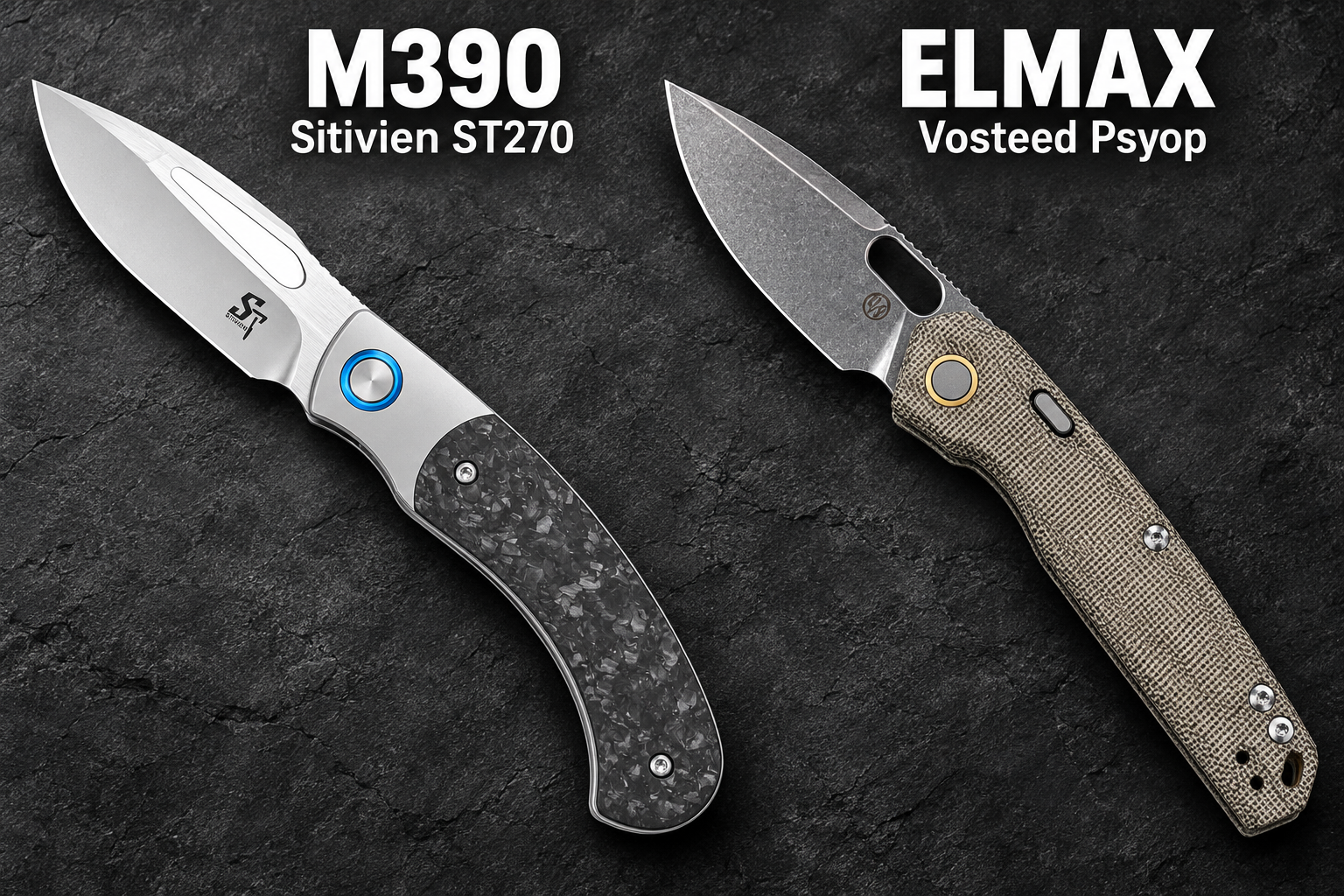
M390 vs. Elmax
The Ultimate Guide to 6 Key Differences

If you’ve spent any time browsing high-end EDC knives, you’ve almost certainly run into these two names. In the M390 vs. Elmax debate, both steels sit at the top of nearly every “best blade steel” list, and for good reason — both are powder-metallurgy stainless steels engineered to deliver a combination of edge retention, corrosion resistance, and toughness that older steels like 154CM or VG-10 simply can’t match. But “premium” doesn’t mean “identical.” M390 and Elmax come from the same manufacturer, use similar production methods, and even share a lot of their alloying elements — yet they behave differently enough on the sharpening stone and in the field that picking between them actually matters. This M390 vs. Elmax breakdown covers where each steel comes from, how their chemistry shapes real-world performance, and which one makes more sense depending on how you actually use a knife.
Quick Answer: M390 edges out Elmax on edge retention and corrosion resistance, making it the better pick for a dedicated EDC blade or dive knife. Elmax is tougher and noticeably easier to sharpen, making it the better pick for hard-use knives or anyone maintaining their own edge at home. In the Elmax vs M390 matchup, neither is a wrong choice — it comes down to how you use the knife.
Where These Steels Come From
Both M390 and Elmax are produced by Böhler-Uddeholm, the Austrian-Swedish steel manufacturer that has become something of a household name in the knife community — even if most buyers have never heard of the company outside of a blade’s spec sheet. M390 is Böhler’s flagship “super steel,” released to compete with the best powder-metallurgy offerings on the market. It’s so respected that other steelmakers produce near-identical equivalents: Crucible’s CPM 20CV and Carpenter’s CTS-204P are functionally the same steel with minor production differences. When you see any of those three names on a knife, you’re getting essentially the same performance. Elmax was actually developed a bit earlier and was originally intended for industrial cutting tools before the knife industry adopted it. It’s a slightly older recipe, but “older” here doesn’t mean “worse” — it means the design goals were a little different, prioritizing a more balanced profile rather than chasing maximum wear resistance.
Breaking Down the Chemistry
Steel performance comes down to composition, so it’s worth looking at what’s actually in each alloy — and the M390 vs. Elmax chemistry gap explains most of the performance differences below. Elmax runs roughly 1.7% carbon, 18% chromium, 3% molybdenum, and 3% vanadium. M390 runs closer to 1.9% carbon, 20% chromium, 1% molybdenum, 4% vanadium, and 0.6% tungsten. The differences that matter most:
- Vanadium and carbon: M390 has more of both, which means more vanadium carbides form in the steel’s microstructure. Vanadium carbides are extremely hard — harder than the steel matrix around them — and they’re the main reason M390 holds an edge so long. More carbides means more wear resistance, but it also means a coarser, more abrasive edge that’s harder to refine on regular stones.
- Chromium: Both steels have plenty for corrosion resistance, but M390’s slightly higher chromium content edges out Elmax here, giving it marginally better rust and stain resistance — useful if a knife sees a lot of moisture, sweat, or saltwater air.
- Molybdenum: Elmax has three times the molybdenum of M390. Moly contributes to toughness and helps refine grain structure, which is part of why Elmax is generally considered the tougher, less brittle of the two steels.
In short: M390 leans harder into wear resistance and corrosion resistance, while Elmax’s chemistry trades a bit of that wear resistance for a tougher, more forgiving blade.
Elmax vs M390: Quick Comparison Chart
| Property | M390 | Elmax |
|---|---|---|
| Manufacturer | Böhler-Uddeholm | Böhler-Uddeholm |
| Composition | ~1.9% C, 20% Cr, 1% Mo, 4% V, 0.6% W | ~1.7% C, 18% Cr, 3% Mo, 3% V |
| Edge Retention | Excellent — better | Very good |
| Corrosion Resistance | Excellent — slightly better | Excellent |
| Toughness | Good | Better |
| Ease of Sharpening | Harder — needs diamond/CBN | Easier — works with more stone types |
| Best For | EDC, dive/fishing knives | Hard use, home sharpeners |
Edge Retention: M390 vs. Elmax
This is the category M390 is famous for. The higher vanadium carbide volume translates directly into a blade that resists abrasive wear — meaning it keeps a working edge through more cardboard, rope, or general EDC tasks before it needs a touch-up. In cutting tests and long-term ownership reports, M390 consistently ranks among the best-performing stainless steels available, often mentioned in the same breath as CPM S90V or CPM 15V, though it doesn’t quite reach those extreme wear-resistance numbers. Elmax isn’t far behind, though. It holds a working edge longer than mid-tier steels like S35VN or D2, and most users would be hard-pressed to notice a difference in day-to-day carry unless they’re doing heavy, repetitive cutting tasks. The gap between M390 and Elmax is real but not dramatic — it shows up more in extended torture tests than in normal EDC use. Winner: M390, but by a smaller margin than the spec sheet numbers might suggest.
Corrosion Resistance
Both steels are excellent here — this isn’t a category where either one will disappoint. M390’s higher chromium content gives it a slight theoretical edge, and it’s often specced into dive knives and other marine-environment tools for that reason. Elmax is still very corrosion-resistant compared to non-stainless or lower-chromium steels, and most owners won’t see a practical difference unless the knife is regularly exposed to saltwater or left wet for extended periods. Winner: M390, marginally.
Toughness
This is where Elmax pulls ahead. The higher molybdenum content and slightly lower carbide volume give Elmax a tougher, more shock-resistant edge — it’s less prone to micro-chipping when it hits something unexpected, like a knot in wood or a bit of bone. M390’s higher hardness and carbide density make it a bit more brittle at the very edge, particularly if it’s ground to a thin, aggressive angle. This doesn’t mean M390 is fragile — plenty of hard-use knives run M390 without issue — but if a knife is going to see batoning, prying, or other tasks that stress the edge, Elmax has a real advantage. Winner: Elmax.
Ease of Sharpening
Anyone who’s put a diamond stone to an M390 blade knows this steel doesn’t sharpen quickly. The dense vanadium carbide structure that gives M390 its edge retention also makes it resistant to abrasion from your sharpening stones — which is great for holding an edge and less great when you actually need to restore one. Diamond or CBN stones are close to mandatory for efficient sharpening; conventional ceramic or Arkansas stones will struggle. Elmax, while still a premium steel that benefits from good abrasives, is noticeably easier to sharpen. It responds better to a wider range of stones and takes a keen edge with less effort, making it more approachable for people who maintain their own knives rather than sending them out or relying on pull-through sharpeners. Winner: Elmax, and this is one of the more noticeable differences between the two in daily ownership.
Cost and Availability
Pricing between the two is generally comparable, though it varies by brand and specific model. M390 has slightly broader availability across production knives — it’s become something of an industry standard for “premium steel” tiers — while Elmax shows up a bit less often but is still well represented, particularly on knives from brands with strong ties to Böhler-Uddeholm sourcing.
M390 vs. Elmax: Which Should You Choose?
For most people, the honest answer is that either steel will outperform 90% of what’s on the market, and the differences described above are more relevant to enthusiasts and reviewers than to someone deciding what to carry to work. That said, here’s a simple way to think about it:
- Choose M390 if maximum edge retention and corrosion resistance are the priority — for a dedicated EDC blade, a dive or fishing knife, or anything that needs to go long stretches between sharpenings.
- Choose Elmax if you want a slightly tougher blade that’s easier to maintain at home, or if the knife is going to see harder use where edge stability matters more than squeezing out the last bit of wear resistance.
Both steels represent what modern powder metallurgy can do, and neither is a wrong choice in the M390 vs. Elmax matchup. The best approach, if you’re on the fence, is to think about how the knife will actually be used — cutting tasks versus hard use, and how often you’re willing to break out the diamond stones — rather than chasing whichever steel wins on paper.
Frequently Asked Questions
Is M390 better than Elmax?
M390 has the edge in raw edge retention and corrosion resistance, so it tends to be the better pick for a dedicated EDC or dive knife. But “better” depends on use case — Elmax is tougher and easier to sharpen, so it’s often the better choice for hard-use knives or anyone who sharpens their own blades regularly.
Is Elmax tougher than M390?
Yes. Elmax’s higher molybdenum content and slightly lower carbide volume make it more resistant to chipping and edge damage under stress, such as batoning or prying. M390’s higher carbide density gives it better wear resistance but makes the edge a bit more brittle by comparison.
Which is easier to sharpen, M390 or Elmax?
Elmax is noticeably easier to sharpen. M390’s dense vanadium carbide structure resists abrasion from sharpening stones the same way it resists abrasion from cutting — which means it holds an edge longer but takes more work (typically diamond or CBN stones) to restore one.
Is Elmax a good stainless steel?
Yes. Elmax is a premium powder-metallurgy stainless steel with excellent corrosion resistance and very good edge retention — it comfortably outperforms mid-tier steels like S35VN or D2, and the M390 vs Elmax gap in day-to-day use is smaller than the spec sheets suggest.