
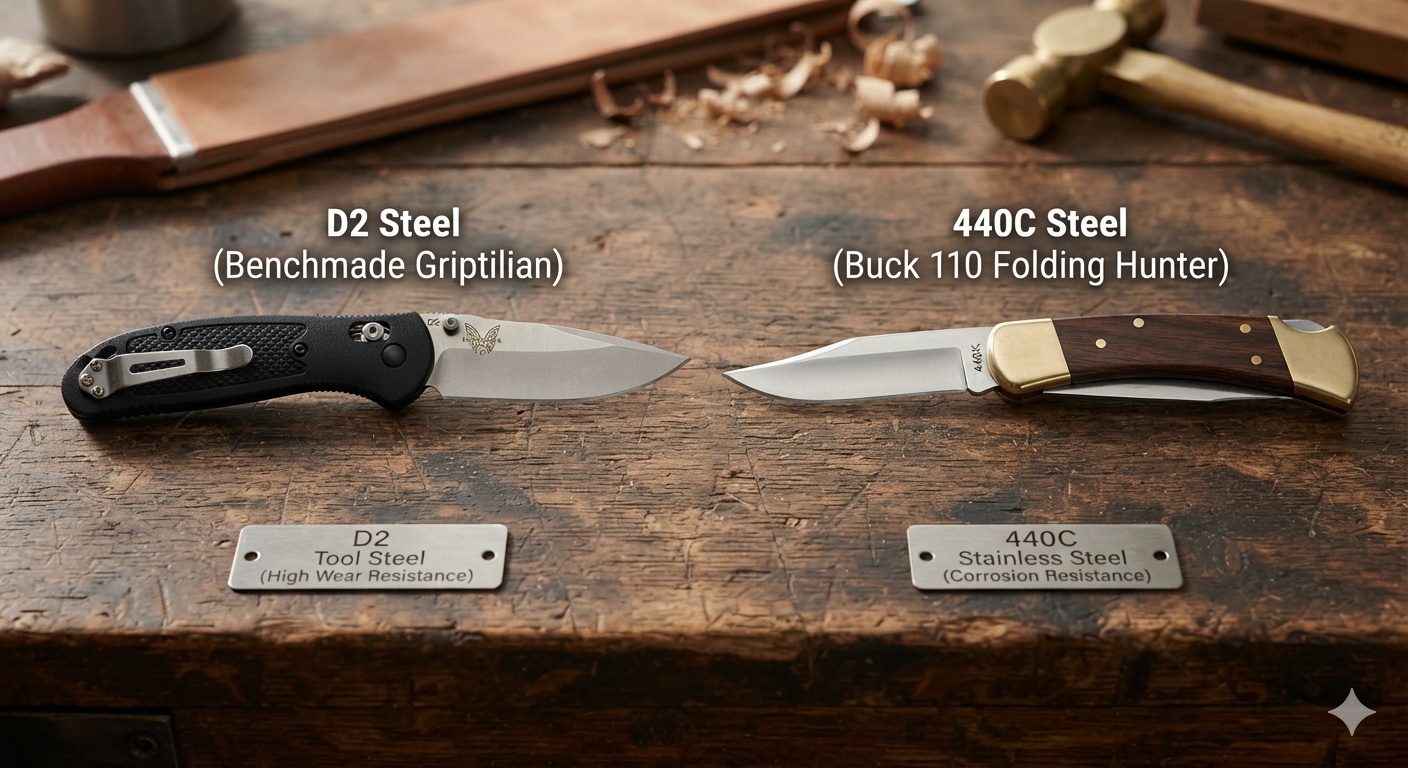
440C vs D2 Steel
The Ultimate Showdown (Which Is Best?)

Choosing the right knife steel can feel overwhelming, especially when navigating the crowded budget-to-mid-range market. The blade steel is the very soul of a knife, dictating how long it stays sharp, how easily it shrugs off rust, and how much abuse it can take before chipping. Two of the most legendary, time-tested options on the market are 440C and D2.
While both have been staples in the knife industry for decades, they serve completely different masters. If you are trying to decide between a knife made from 440C and one made from D2, the choice comes down to a classic material science trade-off: corrosion resistance versus edge retention. This 440C vs D2 steel comparison takes a deep dive into their history, chemistry, performance, and real-world applications to help you make an informed decision.
The Legacy: A Tale of Two Classic Steels
To truly understand how these metals perform, it helps to know where they came from. Neither was originally engineered as pocket knife steel, yet both revolutionized the knife industry.
440C: The High-Chromium Pioneer
440C is a high-carbon martensitic stainless steel developed in the mid-20th century. For decades, it was considered the gold standard for stainless knife steels. Legendary custom maker Bob Loveless popularized its use in the 1970s because it allowed for a mirror-polished finish and excellent stain resistance without sacrificing the ability to hold a decent edge. While it has been surpassed by modern “super steels,” 440C remains a reliable benchmark for high-quality, budget-friendly stainless blades.
D2: The Industrial Tooling Workhorse
D2 steel dates back to World War II, engineered primarily as an industrial tool steel. It was designed for stamping dies, industrial shears, and cutting rollers, tools that had to cut through other metals all day without wearing down. Because of its extreme wear resistance, custom makers and manufacturers eventually adopted it for hard-use outdoor and tactical knives. Today, D2 is the reigning king of the budget-to-mid-tier everyday carry (EDC) market, beloved by users who demand maximum edge longevity.
The TwoSun TS394 With Its Beefy D2 Blade
The Chemistry: What Makes Them Tick?
The performance of any knife steel depends directly on its chemical makeup. The way elements like carbon, chromium, and vanadium blend dictates how long a blade stays sharp, how easily it rusts, and how tough it is under pressure. Here are the raw numbers behind these two alloys.
| Element | 440C Content | D2 Content | Primary Metallurgical Function |
|---|---|---|---|
| Carbon (C) | 0.95% – 1.20% | 1.40% – 1.60% | Increases hardness, strength, and wear resistance. Higher carbon allows D2 to form large, hard carbides. |
| Chromium (Cr) | 16.00% – 18.00% | 11.00% – 13.00% | Provides corrosion resistance. 440C is a true stainless steel, while D2 is classified as semi-stainless. |
| Molybdenum (Mo) | 0.75% | 0.70% – 1.20% | Improves hardenability, toughness, and high-temperature strength during heat treatment. |
| Vanadium (V) | — | 0.90% – 1.10% | Forms very hard vanadium carbides, which increase D2’s wear resistance and refine its grain structure. |
| Manganese (Mn) | 1.00% max | 0.60% max | Increases hardenability and aids grain structure during manufacturing. |
| Silicon (Si) | 1.00% max | 0.60% max | Deoxidizes the steel during melting and slightly enhances overall strength. |
The “Chromium Divide” and Carbide Structures
A steel is generally considered stainless when it has roughly 13% free chromium in its matrix. With up to 18% chromium, 440C easily clears this bar, so it shrugs off moisture, sweat, and humidity.
D2, on the other hand, tops out at 13% total chromium. Because much of that chromium binds with its 1.5% carbon to form chromium carbides, there is less free chromium left to fight off rust. This places D2 firmly in the semi-stainless category.
D2 also has a microstructure dominated by large, coarse carbide clusters, alongside added vanadium. This creates an incredibly wear-resistant edge, whereas 440C has smaller, more evenly distributed carbides that yield a cleaner, smoother finish.
440C vs D2 Steel: Head-to-Head Performance Comparison
To understand how these chemical differences translate into the real world, let’s break down their performance across the four main pillars of knife metallurgy.
1. Edge Retention (Winner: D2)
If your primary goal is a knife that stays sharp through heavy, repetitive cutting, D2 is the clear winner. A steel’s abrasive wear resistance comes largely from its carbon content and the presence of hard alloy carbides.
Because D2 is packed with vanadium and chromium carbides, its edge behaves almost like microscopic serrations. When cutting abrasive materials like cardboard, thick rope, or leather, a D2 blade will maintain a working edge noticeably longer than 440C. A 440C blade will lose its razor edge faster under the same conditions and need more frequent touch-ups.
2. Corrosion Resistance (Winner: 440C)
If you use your knife around water, food, sweat, or humid outdoor environments, 440C is vastly superior. A 440C blade needs very little care to stay bright and rust-free, and it can survive being left damp in a pocket or tackle box without immediate consequences.
In contrast, a D2 blade requires proactive maintenance. It is prone to spotting, pitting, or developing a dark patina if left wet or exposed to acidic foods like apples or tomatoes. If you choose D2, plan on wiping the blade down after use and occasionally applying a light coat of mineral oil.
3. Ease of Sharpening (Winner: 440C)
What D2 gains in edge retention, it pays for at the sharpening bench. The same hard vanadium and chromium carbides that keep the edge from wearing down also make it stubborn to sharpen. Natural Arkansas stones and aluminum oxide blocks tend to struggle with D2, so diamond or silicon carbide abrasives are the better choice.
440C is highly forgiving to sharpen. It responds well to budget-friendly, standard sharpening equipment, and even a beginner can bring a dull 440C blade back to a razor-sharp, polished edge without hours of frustration.
4. Toughness and Chipping Resistance (Winner: Slight Edge to 440C)
Neither of these steels is designed for heavy prying, batoning, or chopping. Both are high-carbon alloys that can be brittle compared to tougher carbon steels like 1095. However, their structural differences change how they fail under stress.
Because D2 contains large, coarse carbide clusters, it has lower impact toughness. If a D2 blade strikes something hard like a rock, staple, or thick bone, it is prone to microscopic chipping along the edge. 440C has a cleaner, more uniform grain structure, which gives it better edge stability and makes it less prone to chipping under sudden impact, though it will roll its edge sooner under heavy force.
Quick Reference Comparison Matrix
Here’s how 440C vs D2 steel stacks up across the main performance pillars, rated from 1 to 10, where 10 is peak industry performance.
| Performance Pillar | 440C Steel | D2 Steel | Key Takeaway |
|---|---|---|---|
| Typical Hardness (HRC) | 58 – 60 HRC | 60 – 62 HRC | D2 runs harder, enabling a longer-lasting edge. |
| Edge Retention | 5 / 10 | 8 / 10 | D2 holds a cutting edge significantly longer. |
| Corrosion Resistance | 8 / 10 | 4 / 10 | 440C resists rust; D2 needs regular oiling. |
| Ease of Sharpening | 7 / 10 | 3 / 10 | 440C is beginner-friendly; D2 works best with diamond stones. |
| Chipping Resistance | 5 / 10 | 4 / 10 | 440C resists chipping slightly better than coarse D2. |
The Wildcard: Heat Treatment Matters
In any 440C vs D2 steel debate, composition is only half the story. The heat treatment process, meaning how the metal is heated, quenched, and tempered, can make or break a knife’s performance.
A poorly heat-treated D2 blade can be a nightmare: brittle, prone to chipping, hard to sharpen, and still unable to hold an edge. On the other hand, reputable manufacturers using a well-dialed heat treat, often including a cryogenic step, can make D2 perform well above its price point. When shopping, the manufacturer’s reputation matters as much as the steel stamped on the blade.
The Verdict: Which One Should You Choose?
When it comes to 440C vs D2 steel, neither is universally better than the other. The best choice depends on your environment, your sharpening skill level, and how you plan to use your blade.
Choose D2 if:
- You want a dedicated everyday carry (EDC) work knife for cutting cardboard boxes, plastic straps, and rope all day.
- You want an outdoor tool or dry-land hunting knife that won’t need touch-ups in the middle of a trip.
- You already own, or plan to invest in, quality diamond sharpening stones.
- You live in a relatively dry climate and don’t mind keeping your tools clean and lightly oiled.
Choose 440C if:
- You are buying a kitchen knife, camp knife, or food-prep tool where rust and metallic-tasting patinas are unacceptable.
- You want a marine or fishing knife that will constantly face humidity, rain, or salt air.
- You prefer a low-maintenance tool you can toss in a pack and forget about until you need it.
- You want a knife that is fast and easy to sharpen back to a razor edge using basic, inexpensive gear.