
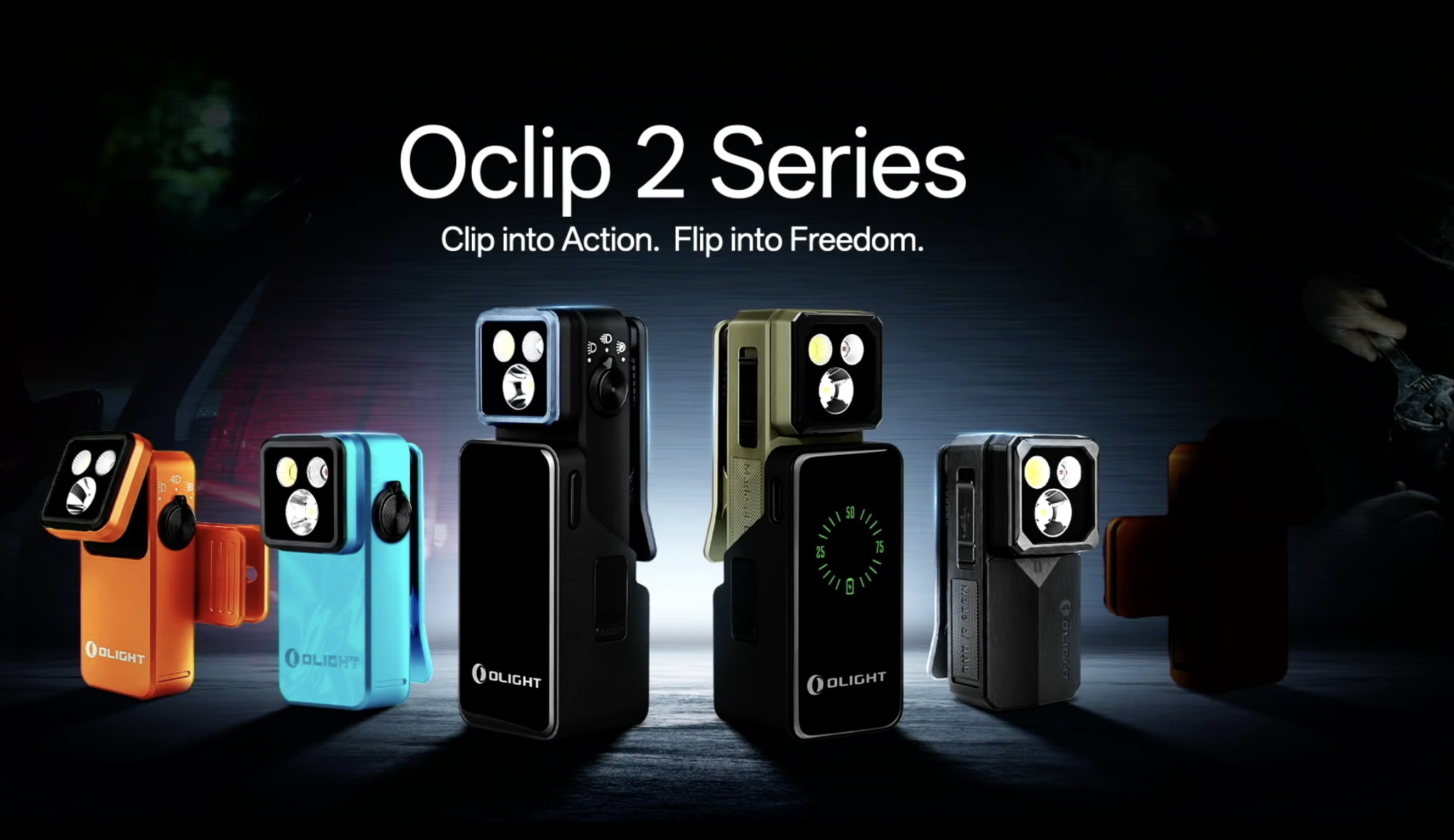
Olight Oclip 2 Series
Oclip 2, Oclip 2 Pro, Oclip 2 Ultra, and the Premium Editions Explained
Olight has a habit of turning a quirky idea into a whole product category, and the Oclip is a good example. The tiny right-angle clip light started as a simple pocket-and-hat accessory. Now it has its own family tree, and the Oclip 2 series is the next branch. The lineup covers the Oclip 2, Oclip 2 Pro, Oclip 2 Ultra, and Premium versions of the Pro and Ultra.
If you carry a pocket knife every day, a clip light is one of the cheapest upgrades you can add to your kit. Below I cover what the Olight Oclip 2 Series is, what’s changed from the first generation, and why Olight’s OAL aluminum deserves a closer look than the marketing usually gives it.
A Quick History of the Oclip
The original Oclip was a small, simple clip-on light. The step up was the Oclip Pro, which added a floodlight, a long-range spotlight, and a red light in a body of roughly 1.87 oz and 2.24 inches long. Then came the Oclip Ultra. It swapped the red LED for a UV light, added a punchier flood and spot, and moved to Olight’s OAL aluminum.
The Ultra set the baseline the new generation has to beat:
- Flood: 530 lumens
- Spot: 450 lumens, reaching about 130 meters
- UV: 800 mW at 365 nm
- Battery: a sealed 580 mAh cell with onboard USB-C charging
- Weight: about 55 grams

The Ultra also used a rotating selector around a side button, an unusually fast control scheme for a light this small.
Reviewers were largely positive about it. One tester found the light hit about 400 lumens on turbo for over a minute, then held around 250 regulated lumens for roughly 80 more minutes. That’s strong performance for a matchbox-sized light with a tiny cell. The criticisms were minor: no red light on the Ultra for people who wanted one, and a power button that can occasionally get bumped if the light isn’t clipped down.
The Oclip 2 Lineup at a Glance
Here’s how the new family breaks down. I’ll update the empty cells once Olight’s spec sheets are live.
| Model | Light sources | Max output | Body | Weight | Price |
|---|---|---|---|---|---|
| Oclip 2 | Spot, Flood, Red, UV | 450-Lumen / 580-Lumen | 6061 Aluminum | 1.5 oz | $39.99 |
| Oclip 2 Pro | Spot, Flood, Red | 530-Lumen | 6061 Aluminum | 2.22 oz | $49.99 |
| Oclip 2 Pro Premium | Spot, Flood, Red | 530-Lumen | 6061 Aluminum | 2.22 oz | $54.99 |
| Oclip 2 Ultra | Spot, Flood, Red, UV | 580-Lumen | OAL | 2.26 oz | $69.99 |
|
OLIGHT Oclip 2 Pro Premium Oclip 2 Holster |
Spot, Flood, Red, UV | 580-Lumen | OAL | 2.26 oz | $83.28 |
The logic of the lineup should feel familiar. In the first generation, the base Oclip, Pro, and Ultra sold at $29.99, $39.99, and $49.99 respectively, with the base model on a plastic lens and the higher tiers on glass. I expect the second generation to follow the same good, better, best structure. That’s an expectation, not a confirmed fact.
What’s New in the Oclip 2
Official details are thin, but early hands-on impressions from an EDC community poster who is testing the Oclip 2 Ultra are informative. They noted:
- It’s noticeably heavier than the first generation, which they called the main drawback.
- It has two magnetic points, where competing clip lights have one.
- The UI, built around the rotary switch, was “stellar” and overall quality seemed superb.
- Both white LEDs are low CRI, which matters if color accuracy is important to you.
- The UV output makes it the only clip light with a UV source, at least as far as that poster knew.
- The Pro has a new articulation feature, which they felt lets it compete with the best in the category.
The weight increase is the one to watch. The original Ultra’s 55 grams was already a selling point, and anything much heavier moves it from “forget it’s there” toward “I notice this in my pocket.”
The dual magnet points are the change I’m most curious about. The first-generation lights had a single magnetic base, so you could stick them to a hood or a fuse box but only in one orientation. A second magnet point should mean more flexible mounting options.
OAL: The Aluminum Behind the Ultra
The biggest talking point of the Ultra tier is the body material. OAL, Olight’s proprietary aluminum alloy, deserves a proper look because the spec-sheet claims sound extraordinary.
What Olight claims. Olight says OAL is 1.73 times harder than 6061 aluminum, with 1.44 times the yield strength and 1.73 times the tensile strength of TA2 titanium. It also describes the alloy as as light as standard aluminum but far tougher. Olight’s own blog goes further, describing it as an aerospace-grade alloy that’s CNC-machined and rivals titanium in yield strength.
Why the 6061 comparison matters. 6061 is the default aluminum for flashlights, knife handles, and a great deal of outdoor gear. It’s a fine material, but it scratches and dings readily, even under hard-anodizing. The first-generation Oclip and Oclip Pro both use it. One review notes that the Oclip and Oclip Pro use standard 6061, which is durable but less rugged than the Ultra’s OAL. So a body that’s around 1.7 times harder should, in principle, resist the everyday abrasion from keys, zippers, and pocket debris much better. That’s exactly the abuse a clip light takes.
OAL already in use for the Oknife Duron. That’s right, OAL has been in use for the Oknife Duron (one of my favorite EDCs). In regard to folding knives, OAL brings an Ultra lightweight, tough and durable handle to the Duron. See the Duron on Youtube.
The titanium comparison needs context. This is where knife people should pay attention. “TA2” is generally regarded as roughly equivalent to commercially pure Grade 2 titanium. That’s the softer, more ductile titanium, not the 6Al-4V alloy most of us associate with premium knife handles and flipper scales. Beating pure titanium on paper is a legitimate technical claim, but it doesn’t mean OAL matches the strength of the titanium you’d find on a $200 knife. Read it as “impressive for an aluminum,” not “aluminum that replaces titanium.”
Hardness isn’t the same as toughness. Harder means better scratch and wear resistance. It doesn’t automatically mean better shock absorption in a drop. In practice a harder body can trade some ability to deform for resistance to scratching, though for a 55-gram light the real-world drop risk is mostly to the lens and the clip, not the body.
What testers actually say. Independent reviewers are more measured than the marketing. One reviewer praised the color and texture of the finish, saying it makes the light feel like a much more expensive item than it is. Another reviewer said the build quality is great but they weren’t sure OAL makes a big practical difference for how they’d use it.
A deal-forum commenter was blunter, saying the special aluminum is somewhat of a gimmick, noting their Arkfeld Ultra picked up more dings and scratches than their Arkfeld Pro despite being newer. Anecdotes like that aren’t lab data, but they’re a useful reality check. Finish quality, anodizing, and how you carry the light all matter as much as the base alloy.
The finish angle. One detail I like is Olight’s olive green color, which the company says is anodized without added pigments. If a finish depends on the alloy’s own anodizing response instead of dyes, it may age more gracefully, and that’s the sort of “fresh over time” behavior a harder alloy should help with. It’s a claim I’d want to test with a few months of pocket carry.
Where else Olight uses OAL. The material isn’t unique to the Oclip. It shows up across the brand, including the Warrior Ultra and the ArkPro Ultra. That tells you Olight is committing to it as a tier identity: “Ultra” now means OAL. For buyers comparing the Olight Oclip 2 Series, the question is whether the Ultra’s OAL body is worth the price gap over the Pro, and I’ll come back to that below.
My take on OAL. It’s a real upgrade in hardness over 6061, and for a pocket-carried light that gets scratched daily, that’s a benefit you’ll see over time. It isn’t magic, and it doesn’t justify the Ultra on its own. Buy the Ultra for the UV light and the extra output. Treat the OAL body as a bonus that keeps the light looking better for longer.
Oclip 2 Pro vs. Oclip 2 Ultra: Which One Fits Your Carry?
The first-generation split translates to the second generation pretty cleanly, though I’ll confirm once specs are official.
Choose the Pro if you want a red light. Red preserves night vision, and for camping, fishing, map reading, and working near sleeping family members, it’s the more practical auxiliary source for most people. One reviewer put it simply: they liked the Pro’s red light more than the Ultra’s UV. The Pro is also typically the cheaper of the two, and the reported articulation feature makes it interesting in its own right.
Choose the Ultra if you want UV and the sturdier OAL body. UV sounds gimmicky until you use it. Practical uses include spotting hidden stains, tracing AC and coolant leaks, checking currency and ID security features, and finding pet accidents. If your daily life includes any of those, the Ultra earns its slot. Just remember the trade-off: the Ultra swaps out the red light entirely.
Skip both and get the base Oclip 2 if you mostly want a simple, light, cheap clip light for the odd dark corner.
What Does “Premium” Mean?
The Premium editions are the newest wrinkle in the lineup. Olight uses “Premium” across other products to signal an upgraded kit or finish, and I’ve seen it attached to the Baton 4 and Javelot lineups. For the Oclip 2 Pro Premium and Oclip 2 Ultra Premium, I don’t yet know whether it means:
- bundled accessory kit, such as the headlamp strap, a pouch, or a case
- a different finish or material treatment
- upgraded internals or output
I’ll update this section the moment Olight spells it out. If the Premium editions simply bundle accessories you’d buy anyway, the price premium might be worth it. If it’s mostly cosmetic, the standard Pro or Ultra is the better value.
The Bottom Line
The Olight Oclip 2 Series looks like a thoughtful evolution of an already-good idea. Two magnet points, a refined rotary interface, and the reported Pro articulation all suggest Olight is improving usability, not just chasing lumens. The likely trade-offs are added weight and low-CRI emitters, which matter if you care about color rendering or keeping your pocket load minimal.
On OAL specifically, it’s a meaningful hardness upgrade over the 6061 aluminum in the Pro and base models, and it should help the light look better after months of carry. It’s also a tier feature more than a game-changer, so pick the Ultra for what it does with light, not only for what it’s made of.
Where to Buy
- Oclip 2 Pro: Check Price
- Oclip 2 Pro Premium: Check Price
- Oclip 2 Ultra: Check Price
- Oclip 2 Ultra Premium: Check Price
- Amazon option: Check Price
Affiliate Disclaimer: I may earn a commission from qualifying purchases made through the links above. This helps support the channel at no additional cost to you.